Showing posts with label worker exposure. Show all posts

Sunday, October 11, 2015

Healthcare Security and Safety Week 2015

This week (October 11-15, 2015) is Healthcare Security and Safety Week. The International Association for Healthcare Security and Safety (IAHSS) established this recognition week to highlight the role of security and safety personnel in healthcare facilities.


Logo for Healthcare Security and Safety Week 2015 from IAHSS

Individuals serving as healthcare security and safety personnel often seem like they are working in the periphery of the healthcare environment - unless the security officers are called to respond to an incident or the safety officer arrives to assist with a chemical spill, you might not notice the valuable work they do to enhance the Environment of Care (EOC).

IAHSS has developed a few key messages associated with Healthcare Security and Safety Week, but I wanted to "flesh out" some ideas about how security and safety team members can be assets to a healthcare organization. Hospitals and other healthcare organizations are ostensibly in the business of helping people to improve or maintain their health. Safety and security team members frequently embrace the more practical aspects of service to patients and clinical staff.

With the IAHSS' theme of "Secure Environment/Safe Care," here are some ways that security and safety team members improve the Environment of Care (EOC) of a healthcare facility:

  • watch for suspicious behavior from visitors and staff members
  • train and educate staff about workplace violence prevention
  • conduct emergency management exercises to allow for continued patient care in the event of a disaster or mass casualty event
  • maintain a cache of food and water to sustain patients, visitors, and staff in an emergency or disaster situation
  • ensure emergency eyewash stations are inspected frequently and function properly
  • assess pressurization of certain areas in the hospital, in order to protect patients from airborne contaminants and lower the risk of healthcare-acquired infections (HAI)
  • support monthly generator testing to ensure emergency power is available
  • train and educate staff about reducing corridor clutter, so as to reduce risks to staff and patients in the event of an evacuation
  • train and educate staff about allowable oxygen tank storage
  • survey the facility for slip, trip, and fall hazards
  • train and educate staff about waste minimization and sustainability initiatives
  • conduct audits of hazardous waste streams (including regulated medical waste and sharps, pharmaceutical waste, chemical waste, etc.) to ensure waste is being handled in an appropriate manner
  • remind staff to wash their hands frequently to prevent disease transmission
  • conduct personal protective equipment (PPE) audits to ensure fellow staff members are wearing PPE when needed
Security and safety team members frequently remind staff members, contractors, and physicans to conduct their healthcare-related work in a way that reduces exposure of coworkers and patients to unnecessary hazards. 

The Industrious Hygienist is part of a pretty fantastic team of healthcare security and safety professionals in Arizona. In recognition of Healthcare Security and Safety Week, here's a shout out to the team (I'm the one with glasses):

Celebrate Healthcare Security and Safety Week with the team from your hospital!

Wednesday, December 24, 2014

Holiday Manga - 2014 - Part Four

Please enjoy the next installment of The Industrious Hygienist's HOLIDAY MANGA.

Here is the finale, Part Four (of Four) for the 2014 Holiday Edition:

The Industrious Hygienist's 2014 Holiday Edition Manga - Part Four
The Exceptional Spouse and I are looking forward to spending the holidays with family and friends, especially the events where Shadow (Alaskan Malamute) gets to come along.

Thanks for continuing to read my blog - expect more safety and industrial hygiene related posts in 2015 and beyond.

Tuesday, December 23, 2014

Holiday Manga - 2014 - Part Three

Please enjoy the next installment of The Industrious Hygienist's HOLIDAY MANGA.

Here is Part Three (of Four) for the 2014 Holiday Edition:

The Industrious Hygienist's 2014 Holiday Edition Manga - Part Three

More to come by the end of the year.

Here are links to Holiday Manga from previous years for your reference and enjoyment:


If you want to review more of my favorite holiday safety tips from industry experts, click here. As always, thanks to Hiromu Arakawa for the Fullmetal Alchemist character stylings. 

Sunday, December 21, 2014

Holiday Manga - 2014 - Part Two

Please enjoy the next installment of The Industrious Hygienist's HOLIDAY MANGA.

Here is Part Two (of Four) for the 2014 Holiday Edition:


The Industrious Hygienist's 2014 Holiday Edition Manga - Part Two
More to come by the end of the year.

Here are links to Holiday Manga from previous years for your reference and enjoyment:


If you want to review my favorite holiday safety tips from industry experts, click here.

Sunday, December 7, 2014

Holiday Manga - 2014 - Part One

In keeping with previous years, I'm doing another series of The Industrious Hygienist's HOLIDAY MANGA!! As a reminder to some of my more impatient :) readers, each of these one page drawings take me between six and eight hours to complete. So, I am working as fast as I can with the limited free time I have available.

Here is Part One (of Four) for the 2014 Holiday Edition:


The Industrious Hygienist's 2014 Holiday Edition Manga - Part One

More to come by the end of the year.

Here are links to Holiday Manga from previous years for your reference and enjoyment:


Friday, November 28, 2014

Sock Puppet Safety: Donning and Doffing PPE for Ebola Virus Disease (EVD) Infection Prevention

The Centers for Disease Control and Prevention (CDC) released improved procedures for donning (putting on) and doffing (taking off) personal protective equipment (PPE) for healthcare workers caring for a patient with suspected or confirmed Ebola Virus Disease (EVD). They have also released some pretty comprehensive video training to show the donning and doffing procedures.

These procedures are explained using two different types of respirators depending on the respirators the hospital may have available:
Image #1: PAPR, image courtesy of the CDC (www.cdc.gov).
Image #2: N95 Respirator, image courtesy of the CDC (www.cdc.gov).
  • Powered Air Purifying Respirator (PAPR): A PAPR with a full face shield, helmet, or headpiece. Any reusable helmet or headpiece must be covered with a single-use (disposable) hood that extends to the shoulders and fully covers the neck and is compatible with the selected PAPR. See Image #1. 
  • N95 Respirator: Single-use (disposable) N95 respirator in combination with single-use (disposable) surgical hood extending to shoulders and single-use (disposable) full face shield. See Image #2.

The CDC reminds hospitals that: "If a NIOSH-certified PAPR and a NIOSH-certified fit-tested disposable N95 respirator is used in facility protocols, [the hospital must] ensure compliance with all elements of the OSHA Respiratory Protection Standard, 29 CFR 1910.134, including fit testing, medical evaluation, and training of the healthcare worker." Since flu season is already upon us, and many hospitals have already started their annual fit testing requirement for use of N95 respirators, this should not be an increased burden on the hospital. 

I watched some of the CDC/Johns Hopkins Medicine videos for EVD PPE donning and doffing and quickly realized that many healthcare workers would start to "zone out" during this web-based video training. This lack of attention during training will be a challenge for hospital administrators, since most hospitals do not have the resources (time or personnel) available to do repeated hands-on training activities. The CDC used to have a poster of the steps for donning and doffing PPE, but it has not been re-released since the new, more comprehensive guidelines were published on October 20, 2014. 

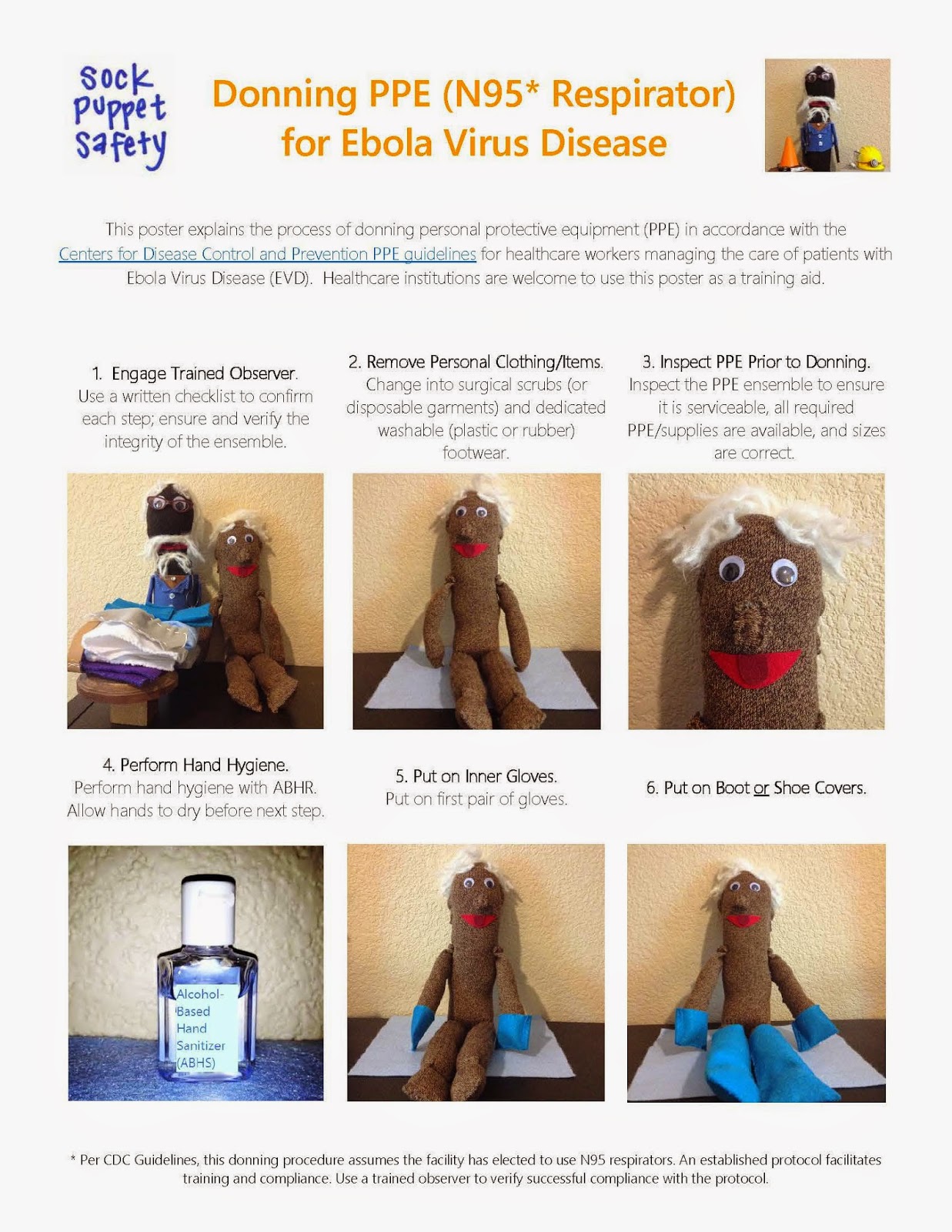
So I decided to make my own PPE posters starring my team at Sock Puppet Safety (more info on that new project later). These posters were designed using the October 2014 CDC guidelines, with a handmade puppet with removable PPE. That's one of the other challenges that hospitals are facing - how to train healthcare workers in donning and doffing without using up all their supplies. Many manufacturers have the CDC required PPE on backorder and many hospitals only have enough to last a few days to care for one patient.

This Infectious Disease PPE Training Poster is brought to you by Sock Puppet Safety - starring Dr. Plurdistein (trained observer) and Peter (shown in proper PPE). 
(As a side note, Peter is named after Peter Piot, the "virus detective" who first unraveled the mystery of Ebola in 1976.)

Here's the front side of the DONNING poster.

Donning PPE (N95 Respirator option) for Ebola Virus Disease, front side. 

Here's the back side of the DONNING poster.
Donning PPE (N95 Respirator option) for Ebola Virus Disease, back side.

Here's the front side of the DOFFING poster.
Doffing PPE (N95 Respirator option) for Ebola Virus Disease, front side.

And, finally, here's the back side of the DOFFING poster.

Doffing PPE (N95 Respirator option) for Ebola Virus Disease, back side.

The donning and doffing protocols are particularly important to reduce the risk of infection of the healthcare worker providing care to the suspected or confirmed EVD patient. 

The waste associated with the EVD patient must be carefully controlled and the donning and doffing procedures are important to reduce the risk of transmission via direct contact with blood and bodily fluids.

The picture above shows EVD as the blue microbes in the mock DOT Category A waste container - these blue microbes are actually Penicillium (Giant Microbes) since they're all I had on hand at the time, but you get the idea. The Ebola Giant Microbe was sold out and won't ship until 12-10-2014.
When a healthcare worker leaves an EVD patient room, they are likely to be covered in Ebola virus from splashes of blood and bodily fluids.
If the donning and doffing procedures are carefully followed, the EVD potential exposure is significantly reduced.
If donning and doffing procedures are not carefully followed, unintentional exposure can happen. In the case of EVD, sharing is NOT caring. 

And yes, those are static-reducing laundry balls that have been broken in half by my overeager Alaskan Malamute. The laundry balls make great fake microbes.

If, for some weird reason, you like the posters and want to use them for training or entertainment purposes, send me an email and I'll be happy to share them. The posters are higher resolution than the images in this blog post.

Happy start to the holiday season from The Industrious Hygienist and her team at Sock Puppet Safety!
Meet the team at Sock Puppet Safety - you'll be seeing more of them in the next few months.


Saturday, November 15, 2014

DIY Safety Data Sheet Revision in Three Easy Steps

Manufacturers and importers of hazardous chemicals have until June 1, 2015 to update their labels and material safety data sheets to be in compliance with the Hazard Communication Standard (HCS) final rule promulgated by the Occupational Safety and Health Administration (OSHA). While you�re patiently waiting for manufacturers to conduct the revisions to labels and updating material safety data sheets to reflect the 16-section format required for Safety Data Sheets (SDS), you still have to train your employees in the new label elements and new SDS format.

OSHA has put together Quick Cards for sample labels and SDS, explaining the new requirements, but some employees and safety professionals may find it difficult to train employees without real, concrete examples. Many manufacturers and importers may also be moving slowly on their revisions due to the perceived difficulty of completing the revisions.

To assist safety professionals and industrial hygienists in their training, here�s some do-it-yourself (DIY) 3-step guidance on preparing your own labels and SDS.

Step 1: Review the requirements for SDS and labels.

First look at the OSHA sample label and list of the 16 required sections for an SDS. If you haven�t looked at your HCP lately, it�s also a good time to revise and update your program. OSHA provides guidance on establishing and maintaining your HCP in their �Small Entity Compliance Guide for Employers That Use Hazardous Chemicals.� 

Next, it might be helpful to review Annex 4 of theGlobally Harmonized System for the Classification and Labelling of Chemicals(GHS), Third Revised Edition (2009). Annex 4 is entitled �Guidance on the Preparation of Safety Data Sheets (SDS)� and explains the purpose of each of the 16 sections in detail. 

Please note that OSHA cannot enforce the content of Sections 12 to 15 of the SDS, as these sections are enforced by other regulatory agencies like the U.S. Environmental Protection Agency (EPA) and U.S. Department of Transportation (DOT) that have not yet adopted GHS.

Step 2: Figure out the hazard classification and category of the substance or mixture.

This is the hardest part of SDS and label preparation � figuring out how to properly classify the substance or mixture. If you want to read through GHS Part 2: Physical Hazards and Part 3: Health Hazards to get an idea of the complexity of this task, you can, but you may find it overwhelming.

You�ll need some knowledge of toxicology and management of hazardous materials to complete this task. If you�re lucky, you�ll find a SDS already prepared by another manufacturer (usually with international capability who already has GHS-compliant SDS) that contains the hazard classification of the substance or mixture.

You have to assess if your chemical constitutes a physical hazard, a health hazard, or both. Some examples of physical and health hazards are included below.

Physical Hazard

Explosives
Flammable Gases
Flammable Aerosols
Gases Under Pressure
Flammable Liquids
Self-Reactive Substances and Mixtures
Pyrophoric Solids
Oxidizing Liquids
Organic Peroxides
Corrosive to Metals

Health Hazard

Acute Toxicity
Skin Corrosion/Irritation
Serious Eye Damage/Eye Irritation
Respiratory or Skin Sensitization
Germ Cell Mutagenicity
Carcinogenicity
Reproductive Toxicity
Specific Target Organ Toxicity � Single Exposure
Specific Target Organ Toxicity � Repeated Exposure
Aspiration Hazard

Physical Hazard: Here�s where the hazardous materials management knowledge will come in handy. You�ll want to find the upper and lower flammable limit/range of your chemical or mixture at standard pressure; understand whether you have a compressed gas, liquefied gas, refrigerated liquefied gas, or dissolved gas; know the flash point for your chemical or mixture; research the burning rate of your flammable solid; research the heat of decomposition; and know the corrosion rate or steel and/or aluminum.

Health Hazard: This is where knowledge of toxicology and ability to search various institutional databases will be useful.

Acute Toxicity:look up the various lethal doses for each anticipated exposure route (oral, inhalation, dermal, etc.). The LD50 indicates the lethal dose in 50% of test subjects (oral, dermal, and other routes) and the LC50 indicates the lethal concentration in 50% of test subjects (inhalation route).

Useful sources for health hazards:

  • National Institutes of Health ToxNet � Hazardous Substances Data Bank (HSDB): Look up the chemical(s) by Chemical Abstract Service (CAS) number or chemical name. This provides information on human health effects, emergency medical treatment, animal toxicity studies, environmental fate, chemical/physical properties, chemical safety and handling, and occupational exposure standards.
  • Centers for Disease Control and Prevention (CDC), National Institute for Occupational Safety and Health (NIOSH) Pocket Guide to Chemical Hazards: Look up the chemical(s) by CAS number of chemical name. This provides the synonyms and trade names, conversion rates, DOT Emergency Response Guide number, Immediately Dangerous to Life and Health (ILDH) concentration, recommended measurement methods, exposure limits, physical description, exposure routes, symptoms, incompatibilities and reactivities, personal protection, and first aid recommendations.
  • Registry of Toxic Effects of Chemical Substances (RTECS), linked from NIOSH Pocket Guide to Chemical Hazards: This provides skin and eye irritation data, mutation data, reproductive effects, and acute toxicity data. 
  • OSHA Occupational Chemical Database: This compiles information from the DOT Emergency Response Guidebook, NIOSH Pocket Guide to Chemical Hazards, and OSHA Chemical Sampling Information webpage.
  • Agency for Toxic Substances and Disease Registry (ATSDR) Toxic Substances Portal: Provides toxicological profiles, public health concerns, and health effects; search by CAS number of chemical name.
  • ATSDR Medical Management Guidelines: Use for basic chemical and exposure information, a summary of potential health effects (acute and chronic), routes of exposure, and incompatibilities.

Step 3: Start Writing the SDS.

Once you have the hazard classification for each chemical or mixture, the rest of the SDS is mostly data gathering.

Section 1 � Identification

Include the product identifier (as used on the label), other means of identification, recommended use, supplier�s details, and emergency phone number.

Section 2 � Hazard Identification

Using the hazard classification, go to Annex 3 for the �Codification of Hazard Statements, Codification and Use of Precautionary Statements and Examples of Precautionary Pictograms.� Look through the listed Hazard Statement codes for physical hazards in Table A3.1.1 and it will tell you what hazard statements and pictograms belong on the SDS and label based on the hazard class. There are also tables for the various Precautionary Statements (prevention, response, storage and disposal). Or, to make it simpler, on page 336 of Annex 3, there is a series of tables encompassing much of the rest of the Annex showing the required signal word, hazard statement, symbol, and precautionary statement(s) based on the hazard classification and associated hazard category. It makes Section 2 very simple to accomplish.

Pictograms can be downloaded as .JPG files from OSHA here.

Health Hazard Pictogram

Section 3 � Composition/Information on Ingredients

This should be present on the original material safety data sheet you are converting to SDS format.

Section 4 � First Aid Measures

This information can be obtained from the NIOSH Pocket Guide to Chemical Hazards, DOT Emergency Response Guidebook, ATSDR Medical Management Guidelines, or ToxNet HSDB. Provide first aid measures for each anticipated route of entry (eye contact, skin contact, inhalation or breathing, ingestion or swallowed).

For information about the most important symptoms (acute and delayed), and indication of immediate medical attention and special treatment needed, the sources listed above for researching health hazards will be useful.

Section 5 � Fire-Fighting Measures

Information from this section can be easily obtained from the NIOSH Pocket Guide to Chemical Hazards and DOT Emergency Response Guidebook, by finding the Guide number that matches the chemical(s) on your SDS and reviewing the emergency response fire information. Make sure to include the ILDH concentration from the NIOSH Pocket Guide to Chemical Hazards, as applicable.

Section 6 � Accidental Release Measures

Information from this section can be easily obtained from the DOT Emergency Response Guidebook, by finding the Guide number that matches the chemical(s) on your SDS and reviewing the emergency response spill or leak information.

Section 7 � Handling and Storage

The precautions for safe handling and conditions for safe storage, including any incompatibilities, is retrievable from the OSHA Occupational Chemical Database, ToxNet HSDB, and NIOSH Pocket Guide to Chemical Hazards. Make sure to include information on whether a safety eye wash and/or shower is required when using this chemical.

Section 8 � Exposure Controls/Personal Protection

Include relevant exposure limits here. It is best practice to include the following for each chemical, as applicable:

This section should also include information if the chemical(s) is a carcinogen, and include engineering controls and personal protective equipment (PPE) for the anticipated routes of entry (eye/face protection, skin protection, respiratory protection).

Useful resources for determining the proper PPE are included below:

Section 9 � Physical and Chemical Properties

This should be present on the original material safety data sheet you are converting to SDS format. Alternatively, the information on each chemical(s) may be able to be obtained from the ToxNet HSDB and the International Chemical Safety Cards by the CDC. The International Chemical Safety Cards can be searched by CAS number, chemical name, RTECS number, and UN number.

Section 10 � Stability and Reactivity

Your research using the ToxNet HSDB, OSHA Occupational Chemical Database, and NIOSH Pocket Guide to Chemical Hazards will have identified the stability and reactivity of the chemical(s) you are researching.

Section 11 � Toxicological Information

Your research using the ToxNet HSDB and ATSDR Toxic Substances Portalwill have given you much of this information. Make sure to verify the carcinogenicity from ACGIH, International Agency for Research on Cancer (IARC), EPA Integrated Risk Information System, National Toxicology Program (NTP), and OSHA.

Section 12 � Ecological Information, Section 13 � Disposal Consideration, Section 14 � Transport Information, and Section 15 � Regulatory Information

These sections are not required by OSHA at this time; you can include the information or state �This section is not required according to 29 CFR 1910.1200(g)(2)� if your SDS is being developed for internal use only.

Section 16 � Other Information

This section can include the date of preparation of the last revision of the SDS, literature references and sources for data used to compile information for the SDS, a key for abbreviations, National Fire Protection Association (NFPA) and Hazardous Materials Information System (HMIS) ratings, and any internal �safety notices� or legalese you�re required to place at the end of every SDS by your corporate counsel.

Completion and Review

Request that a colleague review the SDS for typos and accuracy. Make sure the hazard statements and precautionary statements are correct for the hazard classification and associated category you have selected for the chemical(s) on the SDS. Double check CAS numbers and chemical concentrations.

Once the SDS revision is complete, if you have a need for facility-specific labels, this is a simple process. All the information you need for the label can be copy/pasted from the SDS to the label. The pictograms can be downloaded from OSHA�s Hazard Communication website for use in container labels. You�ll be surprised how much you�ll learn when completing the SDS revision.

Sunday, June 15, 2014

Happy Father's Day! And a new manga.

In honor of Father's Day, I drew this for my father. He's the guy everyone calls when they have a question about computers, or cars, or electrical issues, or pretty much anything...it makes my mother crazy sometimes, but she appreciates his efforts to serve others.

My freshman year in college, I was in multiple car accidents, all minor, one partially my fault. He kept my 1990 Honda Civic (affectionately named Sterling) running from my senior year of high school until I was able to sell it and buy my first new-ish car after I got my first real job out of college.

I learned most of my computer troubleshooting skills from him as well. 

A few years ago, he had a scary encounter with off-the-job chemical exposure that I have memorialized here. 

Thanks for everything you do for me, Dad!

Happy Father's Day from the Industrious Hygienist!

Sunday, June 8, 2014

Thoughts from AIHce 2014 + a new manga!

Howdy, all! I recently returned from the American Industrial Hygiene Conference and Exposition (AIHce) in San Antonio, Texas. It was my first time at this conference, which is a little embarrassing since I am a Certified Industrial Hygienist (CIH) and have been practicing industrial hygiene for 8 years now. But conferences are expensive (!?!) and this year I was self-funded - paid my way entirely from my Spore Consulting, LLC budget. Yay for small business success!

I signed up for the Personal AIHce Liaison (PAL) program at AIHce, and, admittedly, had low hopes for the program. I thought, "Why would someone who has been coming to this conference for years want to hang out with silly little me and show me the best things to do?" It is the first year for the PAL Program at AIHce, and in my opinion, it was a resounding success. My PAL checked in with me every day, made sure I knew when the "cool" parties were, introduced me to some spiffy new people, and even bought me lunch one day. 

To say thanks for my PAL's attention and efforts, and to remember the new colleagues I met, I drew a new manga. If you're new to this blog, the art (actual drawing) is mine, but the character stylings are borrowed from Hiromu Arakawa and Fullmetal Alchemist - my most favorite manga and anime. 


The Personal AIHce Liason (PAL) Program at AIHce 2014 was great!


Tuesday, November 26, 2013

No more weekly inspections of mechanical power presses?

Link to full news release here. Link to Federal Register notice here.

OSHA's most recent national news release discusses outdated or obsolete regulations.

On November 20, 2013, OSHA issued a rule with a notice of proposed rule-making to revise the requirement for weekly inspections of mechanical power presses.

These presses are used to punch holes in and form/assemble metal and other materials. When the presses are not properly maintained or damaged, workers operating the presses can experience injuries on their hands, and arms.

Per the Federal Register notice: "OSHA is revising a provision that requires employers to develop and maintain certification records of periodic inspections performed on the presses by adding a requirement that they develop and maintain certification records of any maintenance and repairs they perform on the presses during the periodic inspections. [...] OSHA is removing the requirement from another provision that employers develop and maintain certification records of weekly inspections and tests performed on the presses." 

OSHA believes that removing the requirement for documented weekly inspection and test certifications will save 613,600 hours of unnecessary paperwork time for businesses. Pending no significantly adverse comments, the final rule will become effective on February 18, 2014.

If this raises your hackles, you may submit comments electronically at www.regulations.gov.

The proposed rule-making would modify the existing standard's maintenance and repair requirements to be in line with the ANSI standard for mechanical power presses. ANSI B11.01-2009 requires that
 maintenance and repair be completed before the press is operated, and that the entire machine be "certified" as being maintained and repaired properly prior to use.

Tuesday, September 24, 2013

Susan Harwood Grant Recipients for 2013

As of September 16, 2013, OSHA has announced the latest round of Susan Harwood Training Grant recipients. OSHA awarded $10.1 million to the various recipients. There's a few that the Industrious Hygienist is really excited about.


From the "targeted topic" list of recipients:


Alaska Marine Safety Education Association, Sitka, AK
Ergonomics, award of $105,300
"The grantee will deliver training on ergonomic hazards for workers in the commercial fishing and fish processing industry. The goal is to educate workers on the basics of ergonomics including assessing ergonomic hazards in the workplace, redesigning work space for improved ergonomics, prevention of musculoskeletal disorders (MSDs) and exercises for preventing and relieving symptoms associated with MSDs. Training will be offered in English, Spanish and Vietnamese."

Why am I excited? The ergonomics recommendations will be focused on the commercial fishing industry, and Alaska Marine Safety Education Association (AMSEA) seems to have excellent outreach to their target population. Their website is informational and well-organized.
Plus, I have an Alaskan Malamute, so our household is a fan of many Alaska-related things. 

National Jewish Health, Denver, CO
Multiple Topics, award of $105,300
"The grantee will develop and deliver training on multiple topics to automotive industry workers. The training will cover hazards to which automotive repair workers, mechanics and technicians can be exposed to in certain jobs including crystalline silica, asbestos, lead, hexavalent chromium and physical hazards that can cause respiratory disease, neurologic problems, skin disorders, allergies, cancer, hearing loss, eye injuries, and ergonomic injuries."

Why am I excited? National Jewish Health has been rated the leading respiratory hospital in the nation. Their mantra of "Science Transforming Life" is at the core of their research activities, which encompass aspects of mycobacteria, environmental health, occupational health, and allergens, all things which are near and dear to the Industrious Hygienist's heart. Interesting note: National Jewish Health first opened in 1899 as a tuberculosis sanitorium. 

Massachusetts Coalition for Occupational Safety and Health, Dorchester, MA
Work Place Violence, award of $104,196
"The grantee will offer work place violence training for young workers and small businesses employing youth. Training will include an introduction to hazard identification and control; worker rights and responsibilities; and the identification and mitigation of work place violence in the retail and healthcare settings. Training activities will utilize participatory learning methods including interactive discussion, case studies, and role playing."

Why am I excited? The MassCOSH group seems to be extensively collaborative and holds a leadership academy for teen workers to promote job safety. Some of their core initiatives are: "Healthy Schools Initiative," "Immigrant Worker Center," "Teens Lead At Work," and a focus on union education and organization. They have articles, reports, and fact sheets from their educational findings. 


In the "capacity building developmental grant" list of recipients:

Board of Regents of UW System for Univ. Wisconsin-Milwaukee, Milwaukee, WI
Safety and Ergonomics Follow-On, award of $148,400
"The grantee will provide training on safety and ergonomics to small utility employees and contractors. The training will target small businesses, non-English speaking/limited English proficiency, minority and other hard to reach workers. The grantee will also develop training materials for employees in the green/renewable power-generation (solar, wind and biofuel) sector in English and Spanish."

Why am I excited? The green/renewable power generation sector needs training and hazard assessments for the work being conducted at the generating sites. 

SEIU Education and Support Fund, Washington, DC
Health Care Industry, award of $177,250
"The grantee will present training to workers employed in the home care, nursing home, and hospital sectors of the health care industry. The target audience will include non-English speaking/limited English proficiency, non-literate and low literacy workers, immigrant and minority workers. The grantee will develop and present a Hazard Communication (HazCom) course in English, Spanish, Chinese, and Russian."

Why am I excited? Healthcare health and safety is my specialty, and since OSHA announced its National Emphasis Program on Nursing Homes and Personal Care Facilities in April 2012, I've been hoping for someone to develop this kind of training.

Thanks to OSHA for offering the Susan Harwood Training Grants. 

Saturday, September 21, 2013

Emergency Preparedness and Response for Floods (e.g. Colorado)

In response to the incredible flooding in Colorado earlier this month, the National Institutes of Health (NIH) via their National Institute of Environmental Health Sciences (NIEHS) published a new web page with information on emergency preparedness and response in flood situations.

See the web page here on floods.

NIEHS emphasized the preparedness factor for responders to flooding, cleanup workers and restoration workers, homeowners, and business owners. The training/information covers safety awareness and post-disaster hazards.

On the page, there's also preparedness information about:

The Industrious Hygienist is always excited to find new references to explore and share with others! Thanks to NIEHS for the useful tools and guidance from a variety of federal departments. 

Sunday, September 15, 2013

Dangit, I missed "Happy N95 Day" on September 5th from NIOSH!

The Industrious Hygienist likes to stay abreast of interesting things in occupational health and safety. The National Institute for Occupational Safety and Health (NIOSH) celebrated its second anniversary of N95 Day on September 5, 2013. 

NIOSH spent the day promoting its Epidemiological Global Health Project (Supercourse), which it developed with the University of Pittsburgh.  NIOSH also promoted their "Know It's NIOSH" campaign, which is dedicated to helping workers understand how to determine if their respirator is NIOSH-approved. The University of Pittsburgh Supercourse has an presentation about the "Know It's NIOSH" campaign, viewable here

Following my commitment to healthcare occupational health and safety, I quickly downloaded the new (June 2013) "Respirator Awareness: Your Health May Depend On It - Personal Protective Equipment for Healthcare Workers" from NIOSH. In a partnership with California Department of Public Health, NIOSH also developed an online toolkit for respirator program administrators in health care workplaces. 

Thanks to NIOSH for developing these helpful courses, toolkits, and helpful infographics, like the one shown below.

NIOSH N95 Day Infographic (c) NIOSH. 
NIOSH made sure to link to the awesome OSHA training videos on respirator protection.

The Industrious Hygienist looks forward to sharing this exciting new information with health care safety professionals for the next few months. 


Thursday, August 22, 2013

Yay! for NIOSH's First Comic: "Straight Talk About Nail-Gun Safety"

So, no surprise, while surfing the 'net for something neat to post about, I came upon some exciting news: NIOSH released their first (ever) comic in June 2013

The comic is titled "Straight Talk About Nail-Gun Safety" and discusses pneumatic nail guns. FYI, careful while searching for images on Google re: "pneumatic nail gun" and "movie" - I tried to find a movie reference/still for visual emphasis, but all that showed up was "Nail Gun Massacre." Not hyper-linked since I am not overly fond of horror movies. 

According to the CDC NIOSH Science Blog, this comic is intended to raise awareness of nail gun safety measures, prevent injuries, and dispel some myths about nail guns circulating around the internet.


CDC NIOSH / Nick Thorkelson comic, "Straight Talk About Nail-Gun Safety"
The comic has a middle section with a nail gun safety checklist that explains nail gun trigger safety, nail gun use, concerns about lumber and building materials, and reminders about compressors and hoses.

It seems they're going for a "those crazy cowboys in the wild west" feel:


Nice 'stache there, buckaroo. :) "Straight Talk About Nail-Gun Safety" CDC NIOSH / Nick Thorkelson
I liked the CDC NIOSH Science Blog's authors' discussion about trying to find a scientific reference for the velocity of a nail shot from a nail gun:

"Most sites that appeared immediately were legal or medical, though they quickly digressed to include �theatrical�, paranormal, and vampire-hunting (using silver nails, we presume) interests.  Narrowing the search to �scholarly� sources, we found several peer reviewed papers that referenced a nail firing velocity of 1400 ft/sec and others that reported different velocities.  (Just to note, no articles were found using these search terms in PubMed or MedLine). All articles except one were medical journal case reports of nail gun injuries."

The CDC seems to be more interested in visual media, since the release of the CDC public health graphic novel, "Preparedness 101: Zombie Pandemic." Comics and graphic novels are a great way to engage the public and workers - telling a story in a way that can help memory retention while entertaining. Nice job, Nick Thorkelson (artist).