Showing posts with label free safety training. Show all posts

Saturday, April 23, 2016

We won first place in ASSE Region 2's OSH Independent Film Festival Contest!

I'm thrilled to share that our latest Sock Puppet Safety video, "Yay for Lab Safety!" won first place in the American Society of Safety Engineers (ASSE) Region 2 OSH Independent Film Festival. The video starred Piper Pangolin, Lemmy Lemur, and two friends.

Piper Pangolin, Industrial Hygienist for Mad Labs, sharing her love of safety!


Thanks to the judges of the contest for their encouraging votes! The Exceptional Spouse and I will use the prize money to fund our time and materials for more Sock Puppet Safety videos.

As a member of the Arizona Chapter of ASSE, the Industrious Hygienist was a speaker at the 2016 Arizona Health and Safety Summit that occurred this week. The session was titled "Do-it-Yourself Safety Data Sheets" and was part of the ASP/CSP preparation track. The breakout session presented by the Industrious Hygienist was written to provide attendees with the knowledge to review safety data sheets (SDS) for accuracy. It also taught attendees how to prepare labels for containers based off of a SDS that was *mostly* compliant with the requirements of the UN Globally Harmonized System for the Classification and Labelling of Chemicals. The session discussed how to write and update a SDS, since some manufacturers are moving slowly on providing GHS-compliant SDS.


In the breakout session, we used a partially GHS-compliant SDS for a made-up chemical called "Wilburn Superflam 70%" to show attendees how to review an SDS for accuracy. 

SDS for Wilburn Superflam, 70% used in ASSE Arizona Health & Safety Summit (2016).
Using the SDS pictured above, the Industrious Hygienist showed attendees how to prepare a container label (like what would be provided by a manufacturer) using the GHS-compliant SDS. The example hazard communication label for Wilburn Superflam 70% is shown below. 

Example hazard communication container label for Wilburn Superflam, 70%.

Our next Sock Puppet Safety video(s) will probably be Piper Pangolin giving specific sections of the "Do-it-Yourself Safety Data Sheets" presentation, and teaching how to develop labels and review SDS. She'll be educating the internet on the chemicals shown in the "Yay for Lab Safety!" video: Wilburn Superflam 70%, Wilcorr Meltymess 25%, and Wilkil Allifes 15%. Watch for more fun and entertaining Sock Puppet Safety videos in upcoming months.

Wednesday, December 16, 2015

Lab Safety Video with Puppets - Courtesy of Oliver Berger

I came across this laboratory safety video by Oliver Berger while searching for my Sock Puppet Safety video on YouTube. I'm sharing it in the interest of science education puppet solidarity. 


It's pretty spiffy to see the kind of improved video quality you get when working with a team of semi-professionals with real sets. Here at Sock Puppet Safety, we're a nerdy husband and wife team with two iPhones and a cheap Canon FS40 video camera. So we're doing the best we can with the limited tech and time available. 

As a side note, we were going to term our sock puppets as "soppets" (because it makes sense), but it looks like there is already a YouTube video channel called "The Amazing Soppets." We haven't watched any of their videos yet. But we're on the hunt for a new term for our sock puppets. 

Sunday, July 5, 2015

Article on Weird Workplace Safety Videos

On July 2, 2015, The Atlantic published an interesting article entitled "In Praise of the Humble Workplace Safety Video" by Sophie Gilbert.

The full article can be accessed here

Ms. Gilbert stated in the article: "There are no statistics relating to whether safety videos actually decrease occurrences of injuries and fatalities in the workplace, but they definitely offer a healthy defense against one serious threat: lawsuits."

A 2006 study in the American Journal of Public Health entitled "Relative Effectiveness of Worker Safety and Health Training Methods" explained that video-based training is one of the least effective intervention methods to improve workers' knowledge of safety and health. Lectures and videos are passive methods that are commonly used in industry to present safety and health information, but were shown in this study to be the least engaging and least effective methods. More engaging methods, such as hands-on demonstrations and participatory discussions, were recommended.

NIOSH also discussed the effectiveness of safety training for workers in a blog post from January 29, 2010. The blog post explained: "In many cases, it was difficult or impossible to draw firm conclusions about the areas we examined due to the lack of quality research. There is a critical need for high quality, controlled studies of workplace health and safety training. That said, given that workplace education and training programs have a positive impact on health and safety behaviors, as we noted earlier in our discussion, and that training and education is a fundamental component of workplace safety and health protections, we recommend that workplaces continue to conduct education and training programs."

In 1999, NIOSH also released a document providing "A Model for Research on Training Effectiveness" that discusses what makes training effective, and explains the Training Intervention Effectiveness Research (TIER) model. The NIOSH document explains that:     

"[...] the most important goal of occupational safety and health training is the long-term reduction of injury and illness among workers. However, a longitudinal study does not meet the immediate evaluation needs of training interventions, and resources for such studies are not readily available. Therefore, occupational safety and health training research usually focuses on representative outcomes (e.g., workers� statements of behavioral intent) that are believed to accurately project unrealized impacts. Representative outcomes include direct results (such as improved attitudes toward risk reduction and hazard control) and intermediate variables (such as changes in work practices among workers who have received training)."

More on safety training and videos later. Happy 4th of July weekend!

Monday, May 25, 2015

#IHFundance - Cautionary Tales in Lab Safety!

Greetings, loyal readers!

Please take 2 minutes out of your very busy day and check out "Cautionary Tales in Lab Safety," our first ever Sock Puppet Safety video on YouTube. This is a video submission for the IH Fundance Film Festival Contest at AIHce 2015 in Salt Lake City, UT.


The Industrious Hygienist will not be able to attend AIHce this year, but if you are going to the conference, please vote for my video! I promise to make more fun videos if we win. 

However, the Industrious Hygienist will be attending Safety 2015 in Dallas, TX in June. I hope to meet up with fellow safety and industrial hygiene nerds - I might even bring a puppet with me. If you're at Safety 2015, please also contribute to my roundtable at Session #625, "Safety Implications of Chemical Disinfectants in Healthcare." 

The roundtable is intended to discuss the following: "Healthcare associated infections represent a significant challenge to patient safety. To control this emerging threat, new chemicals and novel applications of existing chemicals are being marketed heavily to the healthcare industry. This roundtable will discuss challenges and attempt to build consensus on development of a proactive Health & Safety assessment model which balances staff and patient safety."

Wish us luck in the IH Fundance Film Festival! Vote for my puppets!

Leave us comments on YouTube if there are specific safety and industrial hygiene topics you'd like to see acted by our cadre of puppets. 

Saturday, March 7, 2015

Bored in Asbestos Refresher Class?

I spend a lot of time in continuing education classes, including annual asbestos refresher classes. Some of the classes are a regulatory requirement and others are topics I'm interested in. Certifications such as the Certified Industrial Hygienist (CIH), Certified Safety Professional (CSP), and Certified Indoor Environmentalist (CIE) require a certain amount of contact hours for continuing education.

In a given year, I devour an average of 100 hours in conferences, refresher classes, and continuing education as shown below:


I recently spent part of a morning texting a friend/client (at their request) to help them stay awake in asbestos refresher class. This got me thinking about all the times I attempted to keep focused during class in the 8+ years of various asbestos refreshers, to little avail.

Attendees to asbestos refresher class can be very disruptive, using the class as a vehicle to network (loudly) with consultants, contractors, and building owners or representatives. Sometimes they'll spend the entire day texting and emailing, jumping out of their seats to take a call in the lobby, speaking just loud enough so the rest of the class can see how busy and important they are. Others open up their laptops and just work on projects during the refresher class. If there are snacks or coffee provided, you're guaranteed to have some obnoxiously loud slurpers or chewers. 

Here's some of the ways I quietly and unobtrusively entertain myself during asbestos refresher class:


And, of course, I'll pay attention to new letters of interpretation or interesting arguments, answer questions when prompted, and complete the end of course test or assessment in record time.

I drafted this latest Industrious Hygienist manga during the text session with my friend/client, hope you enjoy it.

The Industrious Hygienist is never bored in asbestos refresher class!


Friday, November 28, 2014

Sock Puppet Safety: Donning and Doffing PPE for Ebola Virus Disease (EVD) Infection Prevention

The Centers for Disease Control and Prevention (CDC) released improved procedures for donning (putting on) and doffing (taking off) personal protective equipment (PPE) for healthcare workers caring for a patient with suspected or confirmed Ebola Virus Disease (EVD). They have also released some pretty comprehensive video training to show the donning and doffing procedures.

These procedures are explained using two different types of respirators depending on the respirators the hospital may have available:
Image #1: PAPR, image courtesy of the CDC (www.cdc.gov).
Image #2: N95 Respirator, image courtesy of the CDC (www.cdc.gov).
  • Powered Air Purifying Respirator (PAPR): A PAPR with a full face shield, helmet, or headpiece. Any reusable helmet or headpiece must be covered with a single-use (disposable) hood that extends to the shoulders and fully covers the neck and is compatible with the selected PAPR. See Image #1. 
  • N95 Respirator: Single-use (disposable) N95 respirator in combination with single-use (disposable) surgical hood extending to shoulders and single-use (disposable) full face shield. See Image #2.

The CDC reminds hospitals that: "If a NIOSH-certified PAPR and a NIOSH-certified fit-tested disposable N95 respirator is used in facility protocols, [the hospital must] ensure compliance with all elements of the OSHA Respiratory Protection Standard, 29 CFR 1910.134, including fit testing, medical evaluation, and training of the healthcare worker." Since flu season is already upon us, and many hospitals have already started their annual fit testing requirement for use of N95 respirators, this should not be an increased burden on the hospital. 

I watched some of the CDC/Johns Hopkins Medicine videos for EVD PPE donning and doffing and quickly realized that many healthcare workers would start to "zone out" during this web-based video training. This lack of attention during training will be a challenge for hospital administrators, since most hospitals do not have the resources (time or personnel) available to do repeated hands-on training activities. The CDC used to have a poster of the steps for donning and doffing PPE, but it has not been re-released since the new, more comprehensive guidelines were published on October 20, 2014. 

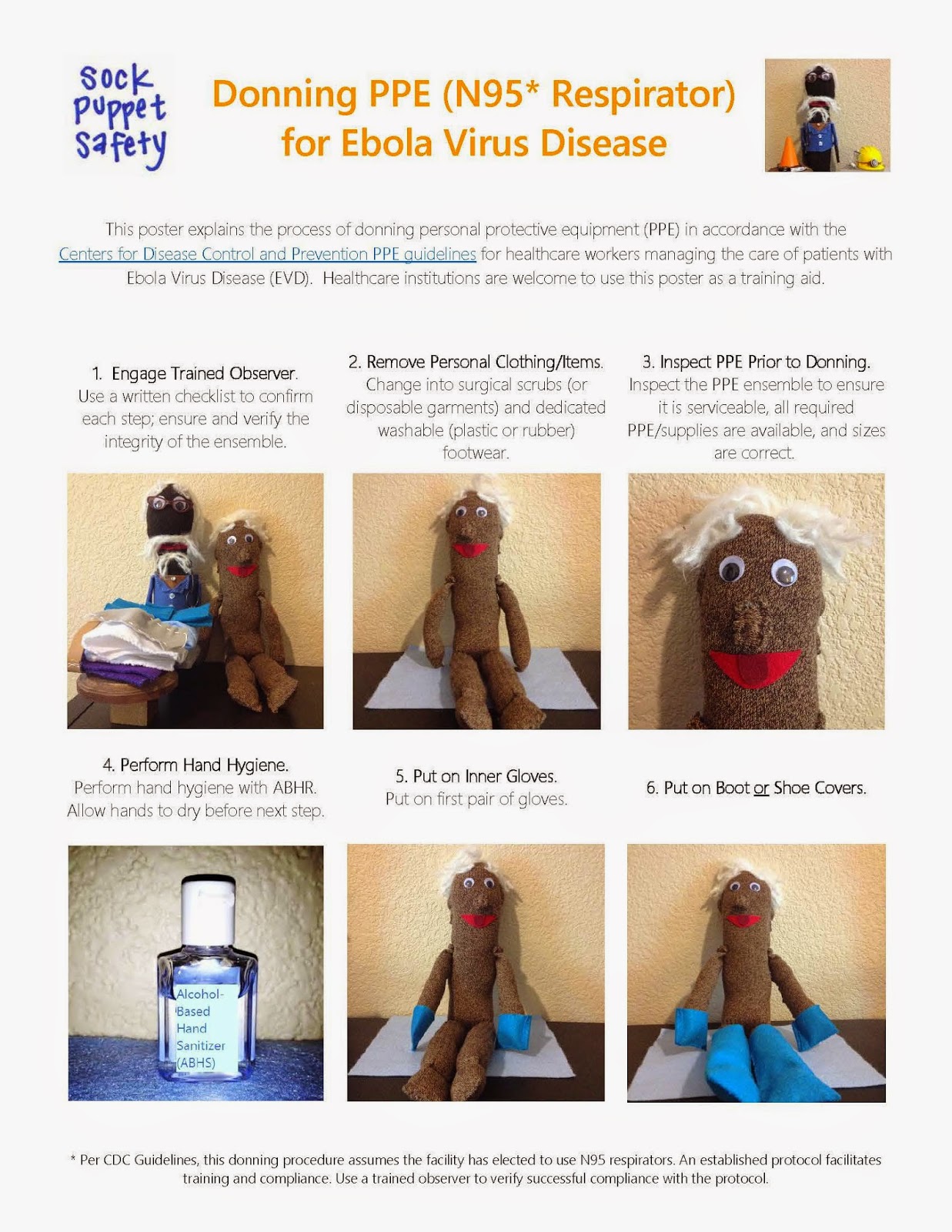
So I decided to make my own PPE posters starring my team at Sock Puppet Safety (more info on that new project later). These posters were designed using the October 2014 CDC guidelines, with a handmade puppet with removable PPE. That's one of the other challenges that hospitals are facing - how to train healthcare workers in donning and doffing without using up all their supplies. Many manufacturers have the CDC required PPE on backorder and many hospitals only have enough to last a few days to care for one patient.

This Infectious Disease PPE Training Poster is brought to you by Sock Puppet Safety - starring Dr. Plurdistein (trained observer) and Peter (shown in proper PPE). 
(As a side note, Peter is named after Peter Piot, the "virus detective" who first unraveled the mystery of Ebola in 1976.)

Here's the front side of the DONNING poster.

Donning PPE (N95 Respirator option) for Ebola Virus Disease, front side. 

Here's the back side of the DONNING poster.
Donning PPE (N95 Respirator option) for Ebola Virus Disease, back side.

Here's the front side of the DOFFING poster.
Doffing PPE (N95 Respirator option) for Ebola Virus Disease, front side.

And, finally, here's the back side of the DOFFING poster.

Doffing PPE (N95 Respirator option) for Ebola Virus Disease, back side.

The donning and doffing protocols are particularly important to reduce the risk of infection of the healthcare worker providing care to the suspected or confirmed EVD patient. 

The waste associated with the EVD patient must be carefully controlled and the donning and doffing procedures are important to reduce the risk of transmission via direct contact with blood and bodily fluids.

The picture above shows EVD as the blue microbes in the mock DOT Category A waste container - these blue microbes are actually Penicillium (Giant Microbes) since they're all I had on hand at the time, but you get the idea. The Ebola Giant Microbe was sold out and won't ship until 12-10-2014.
When a healthcare worker leaves an EVD patient room, they are likely to be covered in Ebola virus from splashes of blood and bodily fluids.
If the donning and doffing procedures are carefully followed, the EVD potential exposure is significantly reduced.
If donning and doffing procedures are not carefully followed, unintentional exposure can happen. In the case of EVD, sharing is NOT caring. 

And yes, those are static-reducing laundry balls that have been broken in half by my overeager Alaskan Malamute. The laundry balls make great fake microbes.

If, for some weird reason, you like the posters and want to use them for training or entertainment purposes, send me an email and I'll be happy to share them. The posters are higher resolution than the images in this blog post.

Happy start to the holiday season from The Industrious Hygienist and her team at Sock Puppet Safety!
Meet the team at Sock Puppet Safety - you'll be seeing more of them in the next few months.


Saturday, November 15, 2014

DIY Safety Data Sheet Revision in Three Easy Steps

Manufacturers and importers of hazardous chemicals have until June 1, 2015 to update their labels and material safety data sheets to be in compliance with the Hazard Communication Standard (HCS) final rule promulgated by the Occupational Safety and Health Administration (OSHA). While you�re patiently waiting for manufacturers to conduct the revisions to labels and updating material safety data sheets to reflect the 16-section format required for Safety Data Sheets (SDS), you still have to train your employees in the new label elements and new SDS format.

OSHA has put together Quick Cards for sample labels and SDS, explaining the new requirements, but some employees and safety professionals may find it difficult to train employees without real, concrete examples. Many manufacturers and importers may also be moving slowly on their revisions due to the perceived difficulty of completing the revisions.

To assist safety professionals and industrial hygienists in their training, here�s some do-it-yourself (DIY) 3-step guidance on preparing your own labels and SDS.

Step 1: Review the requirements for SDS and labels.

First look at the OSHA sample label and list of the 16 required sections for an SDS. If you haven�t looked at your HCP lately, it�s also a good time to revise and update your program. OSHA provides guidance on establishing and maintaining your HCP in their �Small Entity Compliance Guide for Employers That Use Hazardous Chemicals.� 

Next, it might be helpful to review Annex 4 of theGlobally Harmonized System for the Classification and Labelling of Chemicals(GHS), Third Revised Edition (2009). Annex 4 is entitled �Guidance on the Preparation of Safety Data Sheets (SDS)� and explains the purpose of each of the 16 sections in detail. 

Please note that OSHA cannot enforce the content of Sections 12 to 15 of the SDS, as these sections are enforced by other regulatory agencies like the U.S. Environmental Protection Agency (EPA) and U.S. Department of Transportation (DOT) that have not yet adopted GHS.

Step 2: Figure out the hazard classification and category of the substance or mixture.

This is the hardest part of SDS and label preparation � figuring out how to properly classify the substance or mixture. If you want to read through GHS Part 2: Physical Hazards and Part 3: Health Hazards to get an idea of the complexity of this task, you can, but you may find it overwhelming.

You�ll need some knowledge of toxicology and management of hazardous materials to complete this task. If you�re lucky, you�ll find a SDS already prepared by another manufacturer (usually with international capability who already has GHS-compliant SDS) that contains the hazard classification of the substance or mixture.

You have to assess if your chemical constitutes a physical hazard, a health hazard, or both. Some examples of physical and health hazards are included below.

Physical Hazard

Explosives
Flammable Gases
Flammable Aerosols
Gases Under Pressure
Flammable Liquids
Self-Reactive Substances and Mixtures
Pyrophoric Solids
Oxidizing Liquids
Organic Peroxides
Corrosive to Metals

Health Hazard

Acute Toxicity
Skin Corrosion/Irritation
Serious Eye Damage/Eye Irritation
Respiratory or Skin Sensitization
Germ Cell Mutagenicity
Carcinogenicity
Reproductive Toxicity
Specific Target Organ Toxicity � Single Exposure
Specific Target Organ Toxicity � Repeated Exposure
Aspiration Hazard

Physical Hazard: Here�s where the hazardous materials management knowledge will come in handy. You�ll want to find the upper and lower flammable limit/range of your chemical or mixture at standard pressure; understand whether you have a compressed gas, liquefied gas, refrigerated liquefied gas, or dissolved gas; know the flash point for your chemical or mixture; research the burning rate of your flammable solid; research the heat of decomposition; and know the corrosion rate or steel and/or aluminum.

Health Hazard: This is where knowledge of toxicology and ability to search various institutional databases will be useful.

Acute Toxicity:look up the various lethal doses for each anticipated exposure route (oral, inhalation, dermal, etc.). The LD50 indicates the lethal dose in 50% of test subjects (oral, dermal, and other routes) and the LC50 indicates the lethal concentration in 50% of test subjects (inhalation route).

Useful sources for health hazards:

  • National Institutes of Health ToxNet � Hazardous Substances Data Bank (HSDB): Look up the chemical(s) by Chemical Abstract Service (CAS) number or chemical name. This provides information on human health effects, emergency medical treatment, animal toxicity studies, environmental fate, chemical/physical properties, chemical safety and handling, and occupational exposure standards.
  • Centers for Disease Control and Prevention (CDC), National Institute for Occupational Safety and Health (NIOSH) Pocket Guide to Chemical Hazards: Look up the chemical(s) by CAS number of chemical name. This provides the synonyms and trade names, conversion rates, DOT Emergency Response Guide number, Immediately Dangerous to Life and Health (ILDH) concentration, recommended measurement methods, exposure limits, physical description, exposure routes, symptoms, incompatibilities and reactivities, personal protection, and first aid recommendations.
  • Registry of Toxic Effects of Chemical Substances (RTECS), linked from NIOSH Pocket Guide to Chemical Hazards: This provides skin and eye irritation data, mutation data, reproductive effects, and acute toxicity data. 
  • OSHA Occupational Chemical Database: This compiles information from the DOT Emergency Response Guidebook, NIOSH Pocket Guide to Chemical Hazards, and OSHA Chemical Sampling Information webpage.
  • Agency for Toxic Substances and Disease Registry (ATSDR) Toxic Substances Portal: Provides toxicological profiles, public health concerns, and health effects; search by CAS number of chemical name.
  • ATSDR Medical Management Guidelines: Use for basic chemical and exposure information, a summary of potential health effects (acute and chronic), routes of exposure, and incompatibilities.

Step 3: Start Writing the SDS.

Once you have the hazard classification for each chemical or mixture, the rest of the SDS is mostly data gathering.

Section 1 � Identification

Include the product identifier (as used on the label), other means of identification, recommended use, supplier�s details, and emergency phone number.

Section 2 � Hazard Identification

Using the hazard classification, go to Annex 3 for the �Codification of Hazard Statements, Codification and Use of Precautionary Statements and Examples of Precautionary Pictograms.� Look through the listed Hazard Statement codes for physical hazards in Table A3.1.1 and it will tell you what hazard statements and pictograms belong on the SDS and label based on the hazard class. There are also tables for the various Precautionary Statements (prevention, response, storage and disposal). Or, to make it simpler, on page 336 of Annex 3, there is a series of tables encompassing much of the rest of the Annex showing the required signal word, hazard statement, symbol, and precautionary statement(s) based on the hazard classification and associated hazard category. It makes Section 2 very simple to accomplish.

Pictograms can be downloaded as .JPG files from OSHA here.

Health Hazard Pictogram

Section 3 � Composition/Information on Ingredients

This should be present on the original material safety data sheet you are converting to SDS format.

Section 4 � First Aid Measures

This information can be obtained from the NIOSH Pocket Guide to Chemical Hazards, DOT Emergency Response Guidebook, ATSDR Medical Management Guidelines, or ToxNet HSDB. Provide first aid measures for each anticipated route of entry (eye contact, skin contact, inhalation or breathing, ingestion or swallowed).

For information about the most important symptoms (acute and delayed), and indication of immediate medical attention and special treatment needed, the sources listed above for researching health hazards will be useful.

Section 5 � Fire-Fighting Measures

Information from this section can be easily obtained from the NIOSH Pocket Guide to Chemical Hazards and DOT Emergency Response Guidebook, by finding the Guide number that matches the chemical(s) on your SDS and reviewing the emergency response fire information. Make sure to include the ILDH concentration from the NIOSH Pocket Guide to Chemical Hazards, as applicable.

Section 6 � Accidental Release Measures

Information from this section can be easily obtained from the DOT Emergency Response Guidebook, by finding the Guide number that matches the chemical(s) on your SDS and reviewing the emergency response spill or leak information.

Section 7 � Handling and Storage

The precautions for safe handling and conditions for safe storage, including any incompatibilities, is retrievable from the OSHA Occupational Chemical Database, ToxNet HSDB, and NIOSH Pocket Guide to Chemical Hazards. Make sure to include information on whether a safety eye wash and/or shower is required when using this chemical.

Section 8 � Exposure Controls/Personal Protection

Include relevant exposure limits here. It is best practice to include the following for each chemical, as applicable:

This section should also include information if the chemical(s) is a carcinogen, and include engineering controls and personal protective equipment (PPE) for the anticipated routes of entry (eye/face protection, skin protection, respiratory protection).

Useful resources for determining the proper PPE are included below:

Section 9 � Physical and Chemical Properties

This should be present on the original material safety data sheet you are converting to SDS format. Alternatively, the information on each chemical(s) may be able to be obtained from the ToxNet HSDB and the International Chemical Safety Cards by the CDC. The International Chemical Safety Cards can be searched by CAS number, chemical name, RTECS number, and UN number.

Section 10 � Stability and Reactivity

Your research using the ToxNet HSDB, OSHA Occupational Chemical Database, and NIOSH Pocket Guide to Chemical Hazards will have identified the stability and reactivity of the chemical(s) you are researching.

Section 11 � Toxicological Information

Your research using the ToxNet HSDB and ATSDR Toxic Substances Portalwill have given you much of this information. Make sure to verify the carcinogenicity from ACGIH, International Agency for Research on Cancer (IARC), EPA Integrated Risk Information System, National Toxicology Program (NTP), and OSHA.

Section 12 � Ecological Information, Section 13 � Disposal Consideration, Section 14 � Transport Information, and Section 15 � Regulatory Information

These sections are not required by OSHA at this time; you can include the information or state �This section is not required according to 29 CFR 1910.1200(g)(2)� if your SDS is being developed for internal use only.

Section 16 � Other Information

This section can include the date of preparation of the last revision of the SDS, literature references and sources for data used to compile information for the SDS, a key for abbreviations, National Fire Protection Association (NFPA) and Hazardous Materials Information System (HMIS) ratings, and any internal �safety notices� or legalese you�re required to place at the end of every SDS by your corporate counsel.

Completion and Review

Request that a colleague review the SDS for typos and accuracy. Make sure the hazard statements and precautionary statements are correct for the hazard classification and associated category you have selected for the chemical(s) on the SDS. Double check CAS numbers and chemical concentrations.

Once the SDS revision is complete, if you have a need for facility-specific labels, this is a simple process. All the information you need for the label can be copy/pasted from the SDS to the label. The pictograms can be downloaded from OSHA�s Hazard Communication website for use in container labels. You�ll be surprised how much you�ll learn when completing the SDS revision.

Wednesday, January 8, 2014

Useful (and free!) training from FEMA for Industrial Hygienists and Occupational Safety Professionals

While preparing the syllabus and course content for my Spring 2014 course in "Emergency Preparedness and Pre-Planning" at Embry-Riddle Aeronautical University in Prescott, AZ, I developed a list of free training sources available on the Internet for my graduate students to use. 

Sometimes if I'm in need of a quick refresher, I turn to these sources for additional guidance. 

Today's list of courses is from the Federal Emergency Management Agency (FEMA). Their Independent Study Program will give you certificates of completion and even college credit if you need (and pay for) it. The courses are not just about emergency management and preparedness - they cover a range of topics, as you can see below.

Courses that an Industrial Hygienist or Occupational Safety and Health Professional may find useful:

IS-5.a: An Introduction to Hazardous Materials 


Many of these are on my "to do" list (once I have a little free time). According to FEMA's website, the listed courses will take anywhere from 1.5 to 10 hours to complete.

The next few posts will be on free training in mold, asbestos, lead, safety and health management, and other topics of interest to industrial hygiene and safety professionals. These free training courses won't "certify" you to do the work, just raise your awareness and understanding.