Showing posts with label PPE. Show all posts

Saturday, December 6, 2014

New OSHA Fact Sheet - PPE Selection Matrix for Ebola

I'm excited to share an image of the new OSHA Fact Sheet entitled "PPE Selection Matrix for Occupational Exposure to Ebola Virus." My last blog post showed the process for donning and doffing PPE in support of the CDC Guidelines, and starred my team at Sock Puppet Safety.

The Fact Sheet details the recommended PPE based on a variety of occupational exposure scenarios:
  • conducting normal work activities
  • casual interaction (outside of a health care setting)
  • providing medical and supportive care
  • conducting clinical laboratory work
  • conducting research laboratory work
  • handling dead bodies
  • cleaning and disinfecting environments
  • performing maintenance work
  • handling, transporting, and disposing of waste

An image of the PPE selection matrix is shown below - it looks a bit daunting until you see how it is separated out by task.
OSHA's PPE Selection Matrix for Occupational Exposure to Ebola Virus.

So, for a task like handling, transporting, treating, and disposing of waste that is suspected or known to have Ebola Virus contamination (considered Category A waste by the U.S. Department of Transportation), the following PPE is recommended according to the selection matrix:

  • Typical precautions/PPE normally used for the work task
  • Dedicated clothing (uniforms/scrubs/shoes)
  • Gloves, double (nitrile + heavy duty + puncture-resistant)
  • Face mask (e.g., surgical mask)
  • Face and eye protection (e.g., shield/goggles)
  • Fluid-resistant gown
  • Fluid-resistant coveralls
  • Fluid-resistant shoe and boot covers high enough to cover lower leg

The list above is the kind of PPE that would be worn by environmental services workers or waste collection workers in hospitals and other settings, as well as DOT-permitted waste disposal and collection company workers. 

Thanks to OSHA for providing such a useful resource!

Friday, November 28, 2014

Sock Puppet Safety: Donning and Doffing PPE for Ebola Virus Disease (EVD) Infection Prevention

The Centers for Disease Control and Prevention (CDC) released improved procedures for donning (putting on) and doffing (taking off) personal protective equipment (PPE) for healthcare workers caring for a patient with suspected or confirmed Ebola Virus Disease (EVD). They have also released some pretty comprehensive video training to show the donning and doffing procedures.

These procedures are explained using two different types of respirators depending on the respirators the hospital may have available:
Image #1: PAPR, image courtesy of the CDC (www.cdc.gov).
Image #2: N95 Respirator, image courtesy of the CDC (www.cdc.gov).
  • Powered Air Purifying Respirator (PAPR): A PAPR with a full face shield, helmet, or headpiece. Any reusable helmet or headpiece must be covered with a single-use (disposable) hood that extends to the shoulders and fully covers the neck and is compatible with the selected PAPR. See Image #1. 
  • N95 Respirator: Single-use (disposable) N95 respirator in combination with single-use (disposable) surgical hood extending to shoulders and single-use (disposable) full face shield. See Image #2.

The CDC reminds hospitals that: "If a NIOSH-certified PAPR and a NIOSH-certified fit-tested disposable N95 respirator is used in facility protocols, [the hospital must] ensure compliance with all elements of the OSHA Respiratory Protection Standard, 29 CFR 1910.134, including fit testing, medical evaluation, and training of the healthcare worker." Since flu season is already upon us, and many hospitals have already started their annual fit testing requirement for use of N95 respirators, this should not be an increased burden on the hospital. 

I watched some of the CDC/Johns Hopkins Medicine videos for EVD PPE donning and doffing and quickly realized that many healthcare workers would start to "zone out" during this web-based video training. This lack of attention during training will be a challenge for hospital administrators, since most hospitals do not have the resources (time or personnel) available to do repeated hands-on training activities. The CDC used to have a poster of the steps for donning and doffing PPE, but it has not been re-released since the new, more comprehensive guidelines were published on October 20, 2014. 

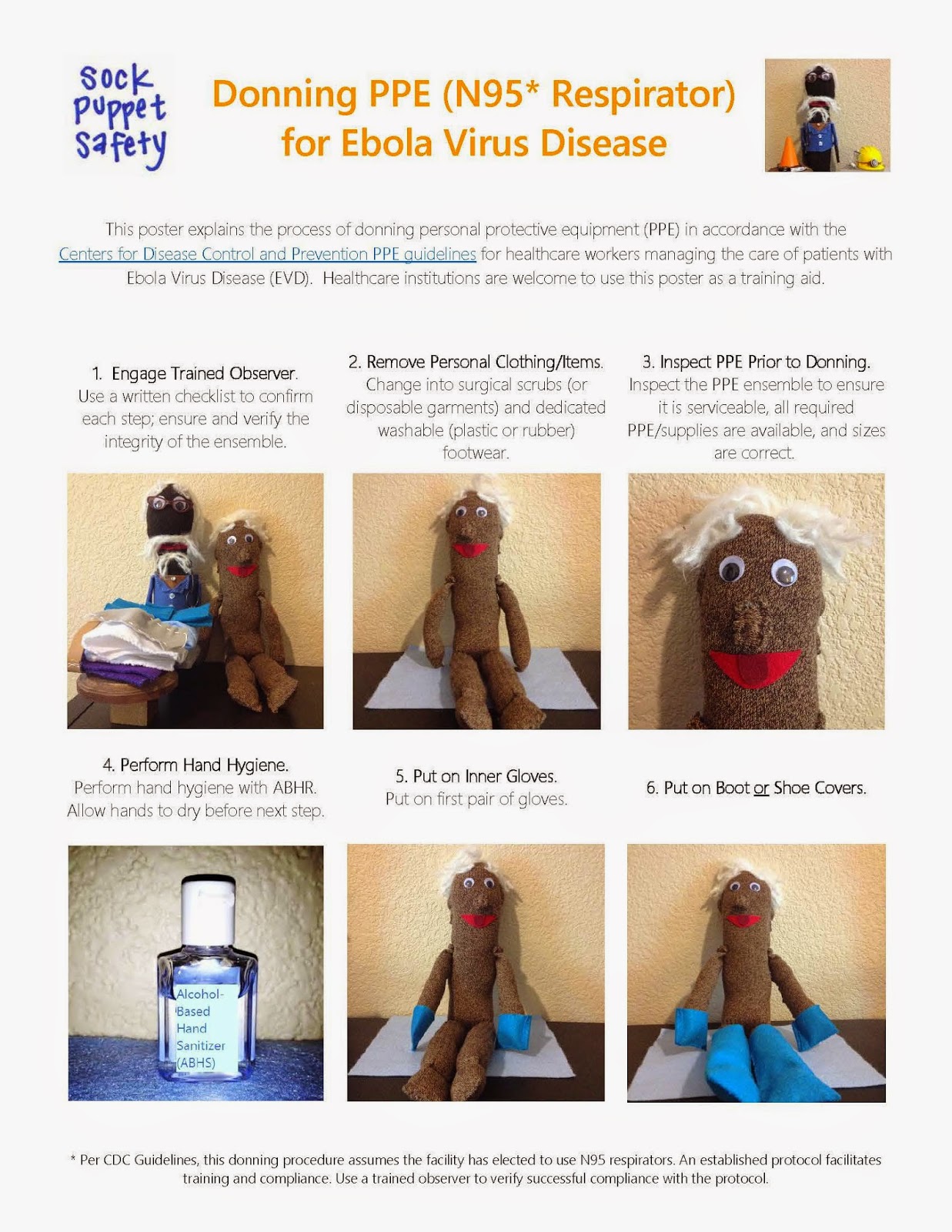
So I decided to make my own PPE posters starring my team at Sock Puppet Safety (more info on that new project later). These posters were designed using the October 2014 CDC guidelines, with a handmade puppet with removable PPE. That's one of the other challenges that hospitals are facing - how to train healthcare workers in donning and doffing without using up all their supplies. Many manufacturers have the CDC required PPE on backorder and many hospitals only have enough to last a few days to care for one patient.

This Infectious Disease PPE Training Poster is brought to you by Sock Puppet Safety - starring Dr. Plurdistein (trained observer) and Peter (shown in proper PPE). 
(As a side note, Peter is named after Peter Piot, the "virus detective" who first unraveled the mystery of Ebola in 1976.)

Here's the front side of the DONNING poster.

Donning PPE (N95 Respirator option) for Ebola Virus Disease, front side. 

Here's the back side of the DONNING poster.
Donning PPE (N95 Respirator option) for Ebola Virus Disease, back side.

Here's the front side of the DOFFING poster.
Doffing PPE (N95 Respirator option) for Ebola Virus Disease, front side.

And, finally, here's the back side of the DOFFING poster.

Doffing PPE (N95 Respirator option) for Ebola Virus Disease, back side.

The donning and doffing protocols are particularly important to reduce the risk of infection of the healthcare worker providing care to the suspected or confirmed EVD patient. 

The waste associated with the EVD patient must be carefully controlled and the donning and doffing procedures are important to reduce the risk of transmission via direct contact with blood and bodily fluids.

The picture above shows EVD as the blue microbes in the mock DOT Category A waste container - these blue microbes are actually Penicillium (Giant Microbes) since they're all I had on hand at the time, but you get the idea. The Ebola Giant Microbe was sold out and won't ship until 12-10-2014.
When a healthcare worker leaves an EVD patient room, they are likely to be covered in Ebola virus from splashes of blood and bodily fluids.
If the donning and doffing procedures are carefully followed, the EVD potential exposure is significantly reduced.
If donning and doffing procedures are not carefully followed, unintentional exposure can happen. In the case of EVD, sharing is NOT caring. 

And yes, those are static-reducing laundry balls that have been broken in half by my overeager Alaskan Malamute. The laundry balls make great fake microbes.

If, for some weird reason, you like the posters and want to use them for training or entertainment purposes, send me an email and I'll be happy to share them. The posters are higher resolution than the images in this blog post.

Happy start to the holiday season from The Industrious Hygienist and her team at Sock Puppet Safety!
Meet the team at Sock Puppet Safety - you'll be seeing more of them in the next few months.


Saturday, November 15, 2014

DIY Safety Data Sheet Revision in Three Easy Steps

Manufacturers and importers of hazardous chemicals have until June 1, 2015 to update their labels and material safety data sheets to be in compliance with the Hazard Communication Standard (HCS) final rule promulgated by the Occupational Safety and Health Administration (OSHA). While you�re patiently waiting for manufacturers to conduct the revisions to labels and updating material safety data sheets to reflect the 16-section format required for Safety Data Sheets (SDS), you still have to train your employees in the new label elements and new SDS format.

OSHA has put together Quick Cards for sample labels and SDS, explaining the new requirements, but some employees and safety professionals may find it difficult to train employees without real, concrete examples. Many manufacturers and importers may also be moving slowly on their revisions due to the perceived difficulty of completing the revisions.

To assist safety professionals and industrial hygienists in their training, here�s some do-it-yourself (DIY) 3-step guidance on preparing your own labels and SDS.

Step 1: Review the requirements for SDS and labels.

First look at the OSHA sample label and list of the 16 required sections for an SDS. If you haven�t looked at your HCP lately, it�s also a good time to revise and update your program. OSHA provides guidance on establishing and maintaining your HCP in their �Small Entity Compliance Guide for Employers That Use Hazardous Chemicals.� 

Next, it might be helpful to review Annex 4 of theGlobally Harmonized System for the Classification and Labelling of Chemicals(GHS), Third Revised Edition (2009). Annex 4 is entitled �Guidance on the Preparation of Safety Data Sheets (SDS)� and explains the purpose of each of the 16 sections in detail. 

Please note that OSHA cannot enforce the content of Sections 12 to 15 of the SDS, as these sections are enforced by other regulatory agencies like the U.S. Environmental Protection Agency (EPA) and U.S. Department of Transportation (DOT) that have not yet adopted GHS.

Step 2: Figure out the hazard classification and category of the substance or mixture.

This is the hardest part of SDS and label preparation � figuring out how to properly classify the substance or mixture. If you want to read through GHS Part 2: Physical Hazards and Part 3: Health Hazards to get an idea of the complexity of this task, you can, but you may find it overwhelming.

You�ll need some knowledge of toxicology and management of hazardous materials to complete this task. If you�re lucky, you�ll find a SDS already prepared by another manufacturer (usually with international capability who already has GHS-compliant SDS) that contains the hazard classification of the substance or mixture.

You have to assess if your chemical constitutes a physical hazard, a health hazard, or both. Some examples of physical and health hazards are included below.

Physical Hazard

Explosives
Flammable Gases
Flammable Aerosols
Gases Under Pressure
Flammable Liquids
Self-Reactive Substances and Mixtures
Pyrophoric Solids
Oxidizing Liquids
Organic Peroxides
Corrosive to Metals

Health Hazard

Acute Toxicity
Skin Corrosion/Irritation
Serious Eye Damage/Eye Irritation
Respiratory or Skin Sensitization
Germ Cell Mutagenicity
Carcinogenicity
Reproductive Toxicity
Specific Target Organ Toxicity � Single Exposure
Specific Target Organ Toxicity � Repeated Exposure
Aspiration Hazard

Physical Hazard: Here�s where the hazardous materials management knowledge will come in handy. You�ll want to find the upper and lower flammable limit/range of your chemical or mixture at standard pressure; understand whether you have a compressed gas, liquefied gas, refrigerated liquefied gas, or dissolved gas; know the flash point for your chemical or mixture; research the burning rate of your flammable solid; research the heat of decomposition; and know the corrosion rate or steel and/or aluminum.

Health Hazard: This is where knowledge of toxicology and ability to search various institutional databases will be useful.

Acute Toxicity:look up the various lethal doses for each anticipated exposure route (oral, inhalation, dermal, etc.). The LD50 indicates the lethal dose in 50% of test subjects (oral, dermal, and other routes) and the LC50 indicates the lethal concentration in 50% of test subjects (inhalation route).

Useful sources for health hazards:

  • National Institutes of Health ToxNet � Hazardous Substances Data Bank (HSDB): Look up the chemical(s) by Chemical Abstract Service (CAS) number or chemical name. This provides information on human health effects, emergency medical treatment, animal toxicity studies, environmental fate, chemical/physical properties, chemical safety and handling, and occupational exposure standards.
  • Centers for Disease Control and Prevention (CDC), National Institute for Occupational Safety and Health (NIOSH) Pocket Guide to Chemical Hazards: Look up the chemical(s) by CAS number of chemical name. This provides the synonyms and trade names, conversion rates, DOT Emergency Response Guide number, Immediately Dangerous to Life and Health (ILDH) concentration, recommended measurement methods, exposure limits, physical description, exposure routes, symptoms, incompatibilities and reactivities, personal protection, and first aid recommendations.
  • Registry of Toxic Effects of Chemical Substances (RTECS), linked from NIOSH Pocket Guide to Chemical Hazards: This provides skin and eye irritation data, mutation data, reproductive effects, and acute toxicity data. 
  • OSHA Occupational Chemical Database: This compiles information from the DOT Emergency Response Guidebook, NIOSH Pocket Guide to Chemical Hazards, and OSHA Chemical Sampling Information webpage.
  • Agency for Toxic Substances and Disease Registry (ATSDR) Toxic Substances Portal: Provides toxicological profiles, public health concerns, and health effects; search by CAS number of chemical name.
  • ATSDR Medical Management Guidelines: Use for basic chemical and exposure information, a summary of potential health effects (acute and chronic), routes of exposure, and incompatibilities.

Step 3: Start Writing the SDS.

Once you have the hazard classification for each chemical or mixture, the rest of the SDS is mostly data gathering.

Section 1 � Identification

Include the product identifier (as used on the label), other means of identification, recommended use, supplier�s details, and emergency phone number.

Section 2 � Hazard Identification

Using the hazard classification, go to Annex 3 for the �Codification of Hazard Statements, Codification and Use of Precautionary Statements and Examples of Precautionary Pictograms.� Look through the listed Hazard Statement codes for physical hazards in Table A3.1.1 and it will tell you what hazard statements and pictograms belong on the SDS and label based on the hazard class. There are also tables for the various Precautionary Statements (prevention, response, storage and disposal). Or, to make it simpler, on page 336 of Annex 3, there is a series of tables encompassing much of the rest of the Annex showing the required signal word, hazard statement, symbol, and precautionary statement(s) based on the hazard classification and associated hazard category. It makes Section 2 very simple to accomplish.

Pictograms can be downloaded as .JPG files from OSHA here.

Health Hazard Pictogram

Section 3 � Composition/Information on Ingredients

This should be present on the original material safety data sheet you are converting to SDS format.

Section 4 � First Aid Measures

This information can be obtained from the NIOSH Pocket Guide to Chemical Hazards, DOT Emergency Response Guidebook, ATSDR Medical Management Guidelines, or ToxNet HSDB. Provide first aid measures for each anticipated route of entry (eye contact, skin contact, inhalation or breathing, ingestion or swallowed).

For information about the most important symptoms (acute and delayed), and indication of immediate medical attention and special treatment needed, the sources listed above for researching health hazards will be useful.

Section 5 � Fire-Fighting Measures

Information from this section can be easily obtained from the NIOSH Pocket Guide to Chemical Hazards and DOT Emergency Response Guidebook, by finding the Guide number that matches the chemical(s) on your SDS and reviewing the emergency response fire information. Make sure to include the ILDH concentration from the NIOSH Pocket Guide to Chemical Hazards, as applicable.

Section 6 � Accidental Release Measures

Information from this section can be easily obtained from the DOT Emergency Response Guidebook, by finding the Guide number that matches the chemical(s) on your SDS and reviewing the emergency response spill or leak information.

Section 7 � Handling and Storage

The precautions for safe handling and conditions for safe storage, including any incompatibilities, is retrievable from the OSHA Occupational Chemical Database, ToxNet HSDB, and NIOSH Pocket Guide to Chemical Hazards. Make sure to include information on whether a safety eye wash and/or shower is required when using this chemical.

Section 8 � Exposure Controls/Personal Protection

Include relevant exposure limits here. It is best practice to include the following for each chemical, as applicable:

This section should also include information if the chemical(s) is a carcinogen, and include engineering controls and personal protective equipment (PPE) for the anticipated routes of entry (eye/face protection, skin protection, respiratory protection).

Useful resources for determining the proper PPE are included below:

Section 9 � Physical and Chemical Properties

This should be present on the original material safety data sheet you are converting to SDS format. Alternatively, the information on each chemical(s) may be able to be obtained from the ToxNet HSDB and the International Chemical Safety Cards by the CDC. The International Chemical Safety Cards can be searched by CAS number, chemical name, RTECS number, and UN number.

Section 10 � Stability and Reactivity

Your research using the ToxNet HSDB, OSHA Occupational Chemical Database, and NIOSH Pocket Guide to Chemical Hazards will have identified the stability and reactivity of the chemical(s) you are researching.

Section 11 � Toxicological Information

Your research using the ToxNet HSDB and ATSDR Toxic Substances Portalwill have given you much of this information. Make sure to verify the carcinogenicity from ACGIH, International Agency for Research on Cancer (IARC), EPA Integrated Risk Information System, National Toxicology Program (NTP), and OSHA.

Section 12 � Ecological Information, Section 13 � Disposal Consideration, Section 14 � Transport Information, and Section 15 � Regulatory Information

These sections are not required by OSHA at this time; you can include the information or state �This section is not required according to 29 CFR 1910.1200(g)(2)� if your SDS is being developed for internal use only.

Section 16 � Other Information

This section can include the date of preparation of the last revision of the SDS, literature references and sources for data used to compile information for the SDS, a key for abbreviations, National Fire Protection Association (NFPA) and Hazardous Materials Information System (HMIS) ratings, and any internal �safety notices� or legalese you�re required to place at the end of every SDS by your corporate counsel.

Completion and Review

Request that a colleague review the SDS for typos and accuracy. Make sure the hazard statements and precautionary statements are correct for the hazard classification and associated category you have selected for the chemical(s) on the SDS. Double check CAS numbers and chemical concentrations.

Once the SDS revision is complete, if you have a need for facility-specific labels, this is a simple process. All the information you need for the label can be copy/pasted from the SDS to the label. The pictograms can be downloaded from OSHA�s Hazard Communication website for use in container labels. You�ll be surprised how much you�ll learn when completing the SDS revision.

Friday, July 18, 2014

Spoggles Redux

They say that imitation is the highest form of flattery, right?

A friend of mine recently noted that if you search for "spoggles" on Google, my blog post from April 23, 2013 was one of the first things to pop up. This was a very exciting thing - I thought I would test it out today.

Imagine my surprise when a FlexiCrew blog post from August 27, 2013 popped up as the first item on Google. 

Me: "Dang, I'm not the first one anymore! Let's see what they have to say. I'll bet mine is better! Mine has cartoons!"

I clicked on their post and immediately realized most of the post was very familiar, because I wrote it last year. I almost always cite my sources or link to original works when "borrowing" material from other blogs or websites. I guess it's silly of me to expect the same effort from other bloggers.

See below for the most obvious examples.

Theirs: So, for those of you not in the environmental health and safety field, Spoggles is an industry term for safety eyewear designed to prevent airborne dust and debris from getting in our eyeballs. Airborne dust and debris is a leading cause of eye injuries in today�s workplaces. Spoggles = Safety + Goggles, with a random �p� thrown in there since �sgoggles� or �sagoggles� or �safoggles� sound even weirder."

Mine: So, for those of you not in the environmental health and safety field [...] Spoggles is an industry term for safety eyewear designed to prevent airborne dust and debris from getting in our eyeballs. Airborne dust and debris is a leading cause of eye injuries in today's workplaces. Spoggles = Safety + Goggles, with a random "p" thrown in there since "sgoggles" or "sagoggles" or "safoggles" sound even weirder.

And it continues...

Theirs: The glasses/goggles are supposed to seal up against your face (via the foam inserts at the interior edges of the lenses), and keep dust out of your eyes. There are potential issues with spoggles, and reasons why people sometimes choose not to wear their personal protective equipment (PPE) when doing work in a dusty environment:

  • the glasses fog up 
  • the glasses can get scratched so it is hard to see 
  • the foam can get �smushed� (technical term) and be less effective 
  • when you take off your glasses, the dust that was at the top and sides/edges of the glasses (and in your eyebrows) can fall right into your eye anyway 
  • some people think they look nerdy (also a technical term) 
  • the earpieces can irritate the heck out of the back of your ears 

Mine: The glasses/goggles are supposed to seal up against your face (via the foam inserts at the interior edges of the lenses), and keep dust out of your eyes. There are potential issues with spoggles, and reasons why people sometimes choose not to wear their personal protective equipment (PPE) when doing work in a dusty environment:

  • the glasses fog up 
  • the glasses can get scratched so it is hard to see 
  • the foam can get �smushed� (technical term) and be less effective 
  • when you take off your glasses, the dust that was at the top and sides/edges of the glasses (and in your eyebrows) can fall right into your eye anyway 
  • some people think they look nerdy (also a technical term) 
  • the earpieces can irritate the heck out of the back of your ears 

And then both blog posts end almost the same way.

Theirs: But looking nerdy and having to take care of your PPE and using good personal hygiene while at work are a small price to pay compared to losing your eyesight or getting a nasty infection in your eye from contaminated dust. So our Flexpert�s advice � Keep a supply of spoggles on hand. With some lanyards. And some no-fog. And to sum up: spoggles are real. Spoggles are good. Spoggles may save your eyesight. Wear them if you have them.

Mine: But looking nerdy and having to take care of your PPE and using good personal hygiene while at work are a small price to pay compared to losing your eyesight or getting a nasty infection in your eye from contaminated dust. [...] Keep a supply of spoggles on hand. With some lanyards. And some no-fog. [...] So, to sum up: spoggles are real. Spoggles are good. Spoggles may save your eyesight. Wear them if you have them.


I'm choosing to not be irritated (although, really, how hard would it have been to say something like, "Thanks, Industrious Hygienist in Arizona, for the original content!" with a link to my blog?). I'm choosing to remember that it doesn't matter how the information gets out to workers, as long as it is effective in helping them realize that PPE is important but has limitations.

And I'm choosing to be flattered. But I may continue to post about spoggles and throw the keyword into a bunch of my new posts just to keep the excitement alive. There will also be a new cartoon about spoggles coming up soon.

Tuesday, December 31, 2013

Industrious Hygienist Holiday Safety Tip #1: Dogs do not mix well with fireworks.

This is Shadow, my 3.5-year old Alaskan Malamute. 

Shadow at 6 months.
Just kidding, this is Shadow. I just wanted to show a picture of him as a puppy. He's ginormous now. 

Shadow on a walk in Prescott Valley - controlled burn in the background.
Shadow is not a fan of New Year's Eve. He hates fireworks. New Year's Eve and Independence Day rank as his least favorite holidays. Some tips for a pet-friendly New Year's party here.  

My end of year cartoon (doubled as a holiday card for clients, colleagues, friends, and family):

The Industrious Hygienist and Shadow enjoy New Year's Eve together. 

We'll be spending New Year's Eve cuddled up in bed, with Shadow alternating between spastic races around the house and cowering next to us in the bedroom. Fun times in the Bliss household!

Wishing all my loyal readers a safe and fulfilling 2014. 

Saturday, September 21, 2013

Emergency Preparedness and Response for Floods (e.g. Colorado)

In response to the incredible flooding in Colorado earlier this month, the National Institutes of Health (NIH) via their National Institute of Environmental Health Sciences (NIEHS) published a new web page with information on emergency preparedness and response in flood situations.

See the web page here on floods.

NIEHS emphasized the preparedness factor for responders to flooding, cleanup workers and restoration workers, homeowners, and business owners. The training/information covers safety awareness and post-disaster hazards.

On the page, there's also preparedness information about:

The Industrious Hygienist is always excited to find new references to explore and share with others! Thanks to NIEHS for the useful tools and guidance from a variety of federal departments. 

Monday, June 17, 2013

National Safety Month - What Does OSHA Say About Emergency Preparedness?

For Week #3 of National Safety Month, I decided to do a short run-down of the various emergency preparedness regulations (and recommendations) from OSHA, USEPA, FEMA, SBA, USDHS, and others. 

Disclaimer: I am not covering anything about OSHA's Process Safety Management (PSM) regulations - it's not my area of expertise. 

So what does OSHA say about emergency preparedness? Lots.

Some helpful references to get you started:
- OSHA's FactSheet on "Planning and Responding to Workplace Emergencies."
- OSHA's Compliance Directive # CPL 2-1.037 "Compliance Policy for Emergency Action Plans and Fire Prevention Plans."
- OSHA's e-Tool for Emergency Evacuation Plans and Procedures.

Let's do a *theoretical* Q&A using the OSHA references provided above.

Q: Do I need an emergency action plan (EAP)?
A: More than likely. Certain workplaces require an EAP, like those using PSM, grain handling, ethylene oxide, and other hazardous chemicals. Almost every business is required to have an emergency action plan (EAP)If fire extinguishers are required or provided in your workplace, and if anyone will be evacuating during a fire or other emergency, then OSHA's 29 CFR 1910.157 requires you to have an EAP.

Q: What needs to be in the EAP?
A: If you have less than 10 employees, be aware that you can communicate the EAP verbally and still be in compliance. 

Your EAP must at least cover the following:

1. Escape procedures and emergency escape route assignments.
2. Procedures to be followed by employees who remain to operate critical plant operations before they evacuate.
3. Procedures to account for all employees after emergency evacuation has been completed.
4. Rescue and medical duties for those employees who are to perform them.
5. Means of reporting fires and other emergencies.
6. Names or job titles of persons who can be contacted for further information or explanation of duties under the plan.

Where can you find an EAP template? The CDC has a Word document template downloadable here. OSHA also has a Emergency Action Plan Expert System that you can use to have a customized EAP for your business. 

Q: How often should I evaluate my EAP?
A. You hopefully reviewed the EAP with employees when the EAP was put in place. The only requirement is to re-evaluate the plan periodically when the plan itself changes, employee responsibilities change, or the exit routes change (i.e. during a building renovation). 

Q: Do I have to train my employees in using fire extinguishers and providing first aid or cardio-pulmonary resuscitation (CPR)?
A: First aid and CPR must be available to employees within 3 to 4 minutes of an emergency. Workplaces that are more than 3 to 4 minutes from an infirmary, clinic, or hospital should have first aid and CPR trained staff on site for all shifts. If there are first aid trained people on staff, you must have first aid supplies, personal protective equipment (PPE), and a bloodborne pathogen program for the designated first responders at your site.

If you require employees to attempt to put out incipient fires using supplied fire extinguishers, then you have to train them how to use the fire extinguishers properly. If your EAP requires all employees to evacuate to safety in case of a fire (no employee fire-fighting required), you can skip the requirement for training in portable fire extinguishers; however, there are still maintenance, inspection, and testing requirements for portable fire extinguishers that must be met. 

Hopefully this helps get your brain ready and excited to learn more about emergency preparedness. 


Thursday, June 13, 2013

My Favorite Quotes from The Hitchhiker's Guide To The Galaxy (Movie)

Here's the original movie trailer and my favorite quotes from The Hitchhiker's Guide to the Galaxy (2005 movie):


Ghostly Image: It is most gratifying that your enthusiasm for our planet continues unabated. As a token of our appreciation, we hope you will enjoy the two thermonuclear missiles we've just sent to converge with your craft. To ensure ongoing quality of service, your death may be monitored for training purposes. Thank you.

The Book: It's an important and popular fact that things are not always what they seem. For instance, on the planet Earth, Man had always assumed that he was the most intelligent species occupying the planet, instead of the *third* most intelligent. The second most intelligent creatures were of course dolphins who, curiously enough, had long known of the impending destruction of the planet earth. They had made many attempts to alert mankind to the danger, but most of their communications were misinterpreted as amusing attempts to punch footballs or whistle for titbits. So they eventually decided they would leave earth by their own means. The last ever dolphin message was misinterpreted as a surprisingly sophisticated attempt to do a double backward somersault through a hoop while whistling the star-spangled banner, but in fact the message was this: So long and thanks for all the fish.

Here's a link to YouTube video of this quote and the song "So Long and Thanks for All the Fish." I dare you not to get it stuck in your head.

Marvin: I've been talking to the main computer.
Arthur: And?
Marvin: It hates me.

The Book: Vogons. They are one of the most unpleasant races in the galaxy. Not actually evil, but bad-tempered, bureaucratic, officious, and callous. They wouldn't even lift a finger to save their own grandmothers from the ravenous Bug-Blatter Beast of Traal without orders signed in triplicate, sent in, sent back, lost, found, queried, subjected to public inquiry, lost again, and finally buried in soft peat for three months and recycled as firelighter. On no account should you allow a Vogon to read poetry to you.

Ah, Vogons. I would link a video, but I haven't found one with decent resolution. Watch the movie if you enjoy British humor, heavy sarcasm, word play, imagination, and general awesomeness.

Wednesday, June 5, 2013

What is OSHA doing about fall prevention?

OSHA's outreach program includes images, posters, wallet cards, etc. that employers can use to educate themselves and their employees.

OSHA has developed a nationwide outreach program for fall prevention. They firmly believe that falls can be prevented and lives can be saved using the simple three steps listed above:
  • Plan - ahead to get the job done safely
  • Provide - the right equipment
  • Train - everyone to use the equipment safely

Here's how OSHA says to do it:

(Don't mind the copy-paste from OSHA's website...they say it better than I could.)

PLAN ahead to get the job done safely

"When working from heights, such as ladders, scaffolds, and roofs, employers must plan projects to ensure that the job is done safely. Begin by deciding how the job will be done, what tasks will be involved, and what safety equipment may be needed to complete each task.

When estimating the cost of a job, employers should include safety equipment, and plan to have all the necessary equipment and tools available at the construction site. For example, in a roofing job, think about all of the different fall hazards, such as holes or skylights and leading edges, then plan and select fall protection suitable to that work, such as personal fall arrest systems (PFAS)."

PROVIDE the right equipment

"Workers who are six feet or more above lower levels are at risk for serious injury or death if they should fall. To protect these workers, employers must provide fall protection and the right equipment for the job, including the right kinds of ladders, scaffolds, and safety gear.
Different ladders and scaffolds are appropriate for different jobs. Always provide workers with the kind they need to get the job done safely. For roof work, there are many ways to prevent falls. If workers use [PFAS], provide a harness for each worker who needs to tie off to the anchor. Make sure the PFAS fits, and regularly inspect all fall protection equipment to ensure it's still in good condition and safe to use."

TRAIN everyone to use the equipment safely

"Falls can be prevented when workers understand proper set-up and safe use of equipment, so they need training on the specific equipment they will use to complete the job. Employers must train workers in hazard recognition and in the care and safe use ladders, scaffolds, fall protection systems, and other equipment they'll be using on the job."

OSHA has provided a bunch of educational materials and resources, training resources, and media resources (images, press releases, etc.) so that employers can be aware of their responsibilities to their employees regarding falls.

Another example of the media available for use from OSHA to train and educate employees, or just serve as a visual reminder on a job site.

Saturday, June 1, 2013

The Industrious Hygienist is celebrating National Safety Month!


Just a heads up that the Industrious Hygienist will be celebrating National Safety Month with other occupational safety and health professionals, including more frequent and more educational blog posts related to the National Safety Council focus areas.

This year's focus areas are:

Week 1: Preventing Slips, Trips, and Falls
Week 2: Employee Wellness
Week 3: Emergency Preparedness
Week 4: Ergonomics

There will be videos, posters/images, fact sheets, and how-to's. Stay posted and  follow me if you want to learn more.

Friday, May 31, 2013

Safety Violations in Hospitality Industry - Hawaii's latest

Kauai Beach Resort faces $50K in fines for safety violations - Thegardenisland.com: Local

Courtesy of The Garden Island, a Kauai hotel (Kauai Beach Resort) received 14 safety and health violations from the OSHA Honolulu office. Several of the violations were classified as serious, involving storage/handling/labeling of propane tanks, electrical wiring, electrical work practices by untrained maintenance personnel, and training and use of personal respiratory and electrical personal protective equipment (PPE).

The hospitality industry is one of the local emphasis programs in place for the Hawaii OSHA office, and they like to focus on the "behind the scenes" areas of the hotels and resorts. This was a routine inspection, not based on any specific complaint.

In April, the OSHA Honolulu office cited the owner of a Waikiki hotel, giving Halekulani Corp. 17 safety violations, 14 of which were classified as serious. These serious violations involved PPE use and availability, fire extinguisher maintenance and inspection, and the providing protective equipment for electrical work. According to the announcement from OSHA, the hotel owners also "failed to provide training in hazardous waste operations and emergency response standards." There were also issues with labeling, access to electrical panels, and issues with labeling on gas tanks.

A common violation in the hospitality industry is the blood borne pathogens standard - laundry and housekeeping staff may have exposure to blood and other potentially infectious materials (OPIM), and per OSHA, "it is the employer's responsibility to determine which job classifications or specific tasks and procedures involve reasonably anticipated contact with blood or OPIM. "

Courtesy of Curtis Law Construction in Kauai, according to Hawaii OSHA representatives, the following are the top violations in Hawaii construction industry (paraphrased from webpage linked above):
  • Fall Protection (lanyards not attached, guardrails and toeboards not sufficient, ladders not secured)
  • Trenching (sloping, shoring, and trench boxes not in compliance, no competent person inspections)
  • Fork Lifts (no certificates of training, no seat belt or horn in use, load capacity not written on forklift)
  • Heavy Equipment (operators not trained properly, no backup alarms, seat belts not being used, brakes not checked, no reflective vests)
  • Cranes (operators not certified, no records or maintenance logs, no electrical safety training, rigging issues, swing radius not barricaded)
  • Electrical Safety (no grounding pins, unlabeled circuit breakers, no front panel, no open space in front of breaker/area in front of panel blocked, lack of outer insulation)
  • General (machine guarding issues, no hazard communication program, insufficient training, PPE not worn or not sufficient)
There is not a Safety/Health Topics page on federal OSHA's website for the hospitality industry, so finding compliance information may be difficult for owners of hotels and other hospitality industry companies. Other locales in the U.S. with a high tourism rate and large number of hospitality industries may notice an uptick in routine inspections at their facilities.

National Safety Month Starts Tomorrow!

June is National Safety Month! The Industrious Hygienist will be very busy in June. I'm scheduled for a four-day Occupational Health and Safety Administration (OSHA) 501 General Industry Outreach Trainer class; this will allow me to provide 10-hour and 30-hour General Industry training to my clients and my future graduate students at Embry Riddle Aeronautical University - Prescott. Thanks to the Arizona Safety Education Center for holding the class. The instructor will be the *illustrious* Harold Gribow

I'm also super-excited to attend Safety 2013 in Las Vegas. I've signed up as a moderator for three sessions. This conference is through the American Society of Safety Engineers (ASSE), and I am stoked to meet the other members of the Industrial Hygiene Practice Speciality (IHPS) and the Healthcare Practice Specialty (HPS)

The National Safety Council (NSC) chose the theme "Safety Starts With Me" and has four focus areas for each week in June. 

Week 1: Preventing Slips, Trips and Falls
Week 2: Employee Wellness
Week 3: Emergency Preparedness
Week 4: Ergonomics


Per NSC, "Successful organizations engage everyone in safety and create a culture where people feel a personal responsibility not only for their own safety, but for that of their coworkers, family and friends. While leadership from the top is important, creating a culture where there is a sense of ownership of safety by all, makes everyone in the organization a safety leader."

On the NSC website, you can sign up for free safety materials, make a safety pledge, and if you're a member, there free weekly webinars and downloadable posters. 

The U.S. Army is joining in National Safety Month as well. They are dedicating a campaign to safety's significance in four key areas: civilian injury prevention, ground operations, aviation operations and off-duty driving.

I especially like the slogan on the poster: "Know the signs. Know what's right. Do what's right."

This encompasses very important facets of safety, including education of employees (they can't "recogize the hazard" if they don't realize it is a hazard) and the emphasis on employee engagement in safety. 

Cintas has provided the following "5 Activities to Engage Employees" for National Safety Month:

1.) Set a company goal for AED/CPR training: Sudden cardiac arrest (SCA), a stoppage of the heart, causes an estimated 15 percent of workplace deaths. Employees who are well-trained in both CPR and automated external defibrillator (AED) use will be fully prepared to respond when SCA occurs. Set a company-wide goal to get a large percentage of workers certified and recognize those individuals who participate in the program by hosting a lunch or picnic. Enlist the help of a training provider and American Heart Association (AHA)-certified instructors to highlight proper AED use and CPR technique.

2.) Fit employees for PPE: Since PPE is only fully effective when it fits correctly, and employees are more likely to wear it when it fits, National Safety Month events are a great opportunity to size employees for gloves, eyewear, hearing protection and protective apparel. PPE that fits properly will not inhibit movement or comfort, but will be tight enough to protect employees during daily activities. Set up fitting stations with several sizes and have a representative on duty who can maintain a log of employees� sizes to make future ordering easier.

3.) Host a safety contest: To keep employees focused and enthusiastic about safety, use contests and trivia to test employee knowledge about correct safety practices. For example, use an �identify what�s wrong with this picture� contest and have employees submit answers for prizes. To maintain engagement over time, launch a recognition program that rewards certain departments or individuals who have shown an exemplary dedication to workplace safety.

4.) Test fire extinguisher skills: Pick a vendor that can be on-site during safety events to train employees on proper fire extinguisher technique using a fire simulator. Then, test employees� knowledge with oral quizzes and online training courses. In addition, make sure employees know where all extinguishers and exits are located throughout the facility so they can be fully prepared if a fire occurs.

5.) Teach emergency response: A common misconception is that employees know how to properly respond in the event of an emergency. Use safety awareness events to teach employees proper response including evacuation protocol, first-aid techniques and how to call for help during an emergency. Assign stand-out employees to emergency response teams that can correctly handle chemical spills, fires, natural disasters and SCA. 

What's your plan for National Safety Month?